Support
March 2, 2026
The Losses That Don't Get a Funeral: Navigating Disenfranchised Grief
We are living in a world that only knows how to grieve death.
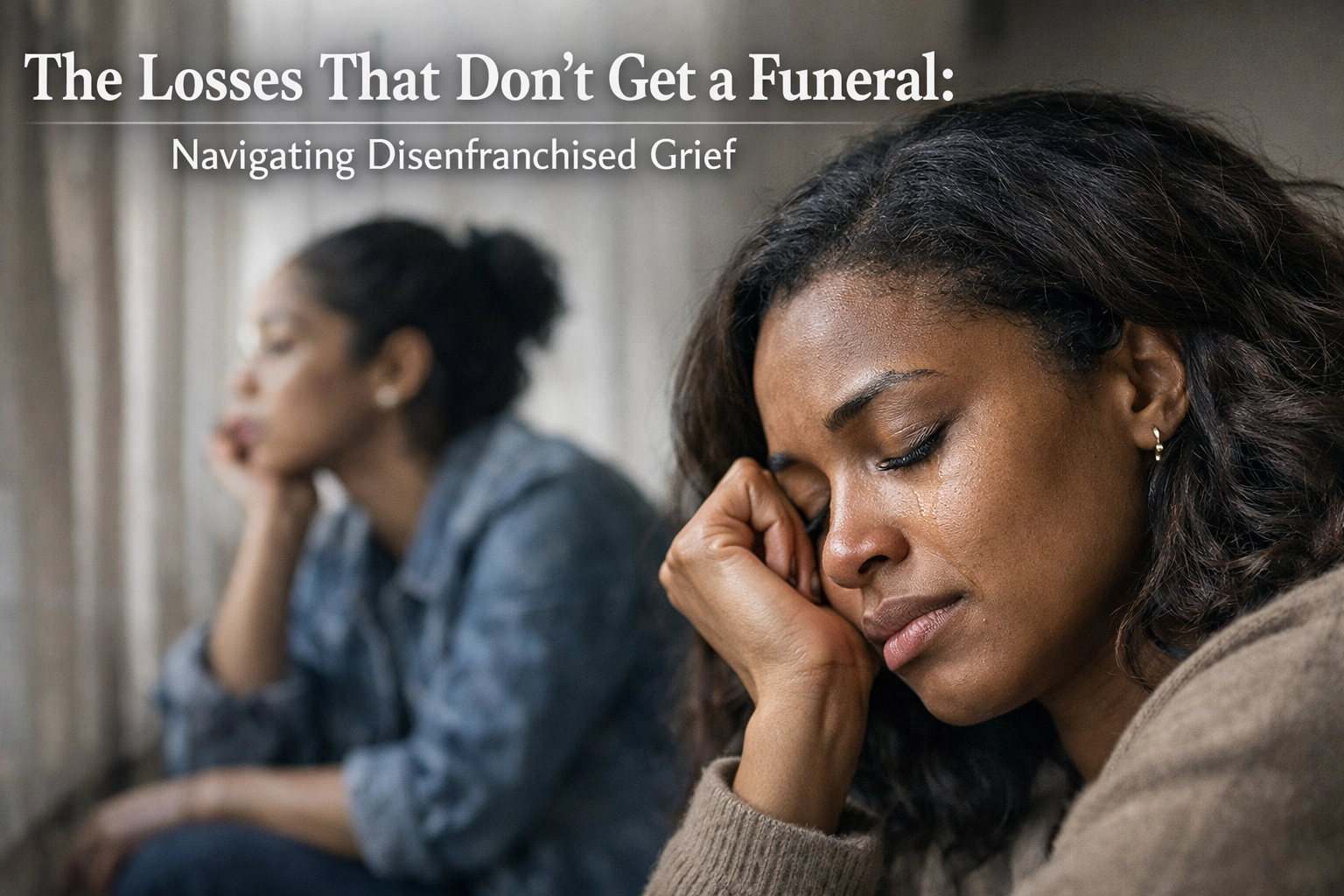
But what happens when the loss you're carrying doesn't come with a casket? What happens when the grief you feel, the profound void in your heart, has no funeral, no flowers, no acknowledgment from the people around you?
What happens when society looks at your pain and says: "That's not real grief"?
This is called disenfranchised grief, and it's one of the most devastating forms of loss we experience as women impacted by the criminal legal system. It's the grief of losing your identity when you get a record. The grief of losing time you'll never get back. The grief of losing your sense of self-worth in a system designed to strip it away.
These losses are real. They are heavy. And they deserve to be mourned.
What Is Disenfranchised Grief?
Disenfranchised grief is grief that society refuses to validate, acknowledge, or support. It's the kind of loss that leaves you grieving alone, without the communal recognition that's typically given to traditional deaths.
According to grief researchers, disenfranchised grief occurs when:
- The loss itself isn't seen as worthy of grief (job loss, loss of freedom, loss of reputation)
- The relationship is stigmatized (loss of a partner while incarcerated, loss of parental rights)
- The mechanism of loss carries stigma (incarceration, overdose, suicide)
- The griever isn't recognized as legitimate (formerly incarcerated individuals, probationers, people with records)
Did you know? Studies show that people experiencing disenfranchised grief are at significantly higher risk for depression, anxiety, and complicated grief reactions because they are denied the social support systems that help others heal.
For women who have been touched by the criminal legal system, disenfranchised grief isn't abstract, it's daily reality.

The Losses No One Sees: Identity, Time, and Self-Worth
Let's talk about the losses that don't get a funeral. The ones society tells you to "get over" or "move on from" without ever acknowledging what was taken.
Loss of Identity
When you get a record, you don't just lose freedom, you lose who you are.
The labels start coming: "offender," "criminal," "felon," "inmate number." And slowly, those labels begin to replace your name. They replace your story. They replace the fullness of who you were before the system touched you.
You become what happened to you, not who you are.
This is identity death. And it's grief.
You grieve the version of yourself who walked freely without being followed by a file. You grieve the trust people used to have in you. You grieve the ease with which you once moved through the world.
Research shows that up to 70% of formerly incarcerated women report struggling with identity confusion and feelings of "not knowing who they are anymore" post-release. Yet when we express this loss, society often responds with: "Well, you did the crime."
As if punishment erases personhood.
As if consequences should include permanent identity erasure.
Loss of Time
Time doesn't stop when you're incarcerated: but your life does.
While you're inside, the world keeps moving. Your children grow. Your parents age. Holidays pass. Graduations happen. Weddings take place. Deaths occur. And you? You lose the ability to be present for any of it.
Even after release, that time is gone. You can't get it back. You can't rewind and show up for the moments you missed. You carry the weight of all those absences: birthdays you couldn't celebrate, bedtime stories you couldn't read, hands you couldn't hold.
And when you try to talk about it, people often say: "At least you're out now. Focus on the future."
But how do you focus on the future when the past is an open wound no one will acknowledge?
Did you know? The average woman serves 18 months in prison, but research indicates that the psychological impact of "stolen time" can last for decades, contributing to chronic depression and post-traumatic stress.
This is cumulative loss. This is time grief. And it is real.
Loss of Self-Worth
Perhaps the most insidious loss of all is the loss of self-worth.
The criminal legal system doesn't just punish actions: it punishes humanity. It strips dignity. It removes autonomy. It treats you like you are less than, undeserving, disposable.
And after years of being told you are "bad," "broken," or "unworthy," something dangerous happens: you start to believe it.
You start to question whether you deserve love, whether you deserve forgiveness, whether you deserve to take up space in this world.
This is disenfranchised grief at its most cruel: when the loss isn't just external, but internal. When you've lost your sense of self.
Studies show that women impacted by incarceration are three times more likely to experience chronic shame and low self-esteem compared to the general population. These emotional wounds don't heal on their own. They require intentional, compassionate grief work.
But society doesn't give you space to grieve your self-worth. Instead, it tells you to "be grateful" and "earn your place back."
As if healing is conditional.
As if you need permission to reclaim your humanity.
Why Disenfranchised Grief Is So Dangerous
When grief is disenfranchised: when it's denied, minimized, or dismissed: it doesn't disappear. It intensifies.
Without acknowledgment and support, grief gets trapped inside the body. It manifests as:
- Depression and anxiety (unprocessed grief turning inward)
- Substance use (attempting to numb pain no one will witness)
- Physical symptoms (muscle tension, chronic pain, digestive issues)
- Isolation and withdrawal (believing no one understands or cares)
- Difficulty forming healthy relationships (fear of being seen and rejected)
- Inability to cope with future losses (unresolved grief compounding over time)
Did you know? Research shows that individuals with disenfranchised grief are 2.5 times more likely to develop complicated grief disorder: a condition where grief becomes chronic and debilitating.
For women in the criminal legal system, this is compounded by the fact that we're often expected to be "resilient" and "strong" without being given the resources to actually heal.
We're told to keep moving, keep surviving, keep proving ourselves: all while carrying grief that no one will name.
That's not resilience. That's survival without support. And it's exhausting.
Naming the Grief: The First Step Toward Healing
Here's what we know to be true: We cannot heal what we do not name.
If your grief has been dismissed, minimized, or ignored: we see you. We witness you. And we want you to know: your grief is legitimate.
You are allowed to grieve:
- The person you were before the system touched you
- The time you lost that you'll never get back
- The relationships that changed or ended
- The dreams that were interrupted or destroyed
- The dignity that was taken from you
- The self-worth that was systematically eroded
You don't need anyone's permission to mourn these losses. You don't need a casket or a funeral program to validate your pain.
Your loss is real. Your grief is real. And you deserve space to feel it.
At Ayana Thomas Initiative LLC, we specialize in helping women navigate the grief that society refuses to acknowledge. We work specifically with women impacted by the criminal legal system because we understand that your losses are layered, complex, and deserving of witness.
Our Grief Behind the Gavel program was created for women like you: women who are carrying invisible grief and need a space to finally name it, feel it, and heal from it.
How to Navigate Disenfranchised Grief
If you're living with grief that no one sees, here's what we want you to know:
1. Validate Your Own Experience
You don't need external validation to know that what you're feeling is real. Trust yourself. Trust your grief. The intensity of your pain reflects the significance of your loss: not society's willingness to acknowledge it.
2. Seek Understanding Supporters
Not everyone will understand your grief, and that's okay. But you deserve to be around people who do. Consider joining a grief support group, working with a counselor who understands carceral trauma, or connecting with others who have walked a similar path.
Our Individual Grief Counseling services provide a safe, non-judgmental space for you to process your losses with someone who truly gets it.
3. Don't Suppress Your Grief
Suppressing grief doesn't make it disappear: it magnifies it. Give yourself permission to feel. Cry. Rage. Write. Create. Move your body. Do whatever you need to do to release what's been trapped inside.
4. Create Your Own Rituals
If society won't give your loss a funeral, create your own rituals of mourning. Light a candle. Write a letter to your former self. Create art. Plant something. Honor your loss in whatever way feels sacred to you.

We're Here to Help You Grieve Back to Life
At Ayana Thomas Initiative LLC, we believe that healing is not a luxury: it's a necessity. And we believe that every woman, regardless of her past, deserves the chance to grieve fully, heal deeply, and reclaim her life.
If you've been carrying grief that no one will acknowledge, we want you to know: we see you, we believe you, and we're here to walk with you.
You don't have to grieve alone anymore.
Learn more about our services and how we support women in navigating disenfranchised grief at www.grievingbacktolife.com.
Your grief matters. Your healing matters. You matter.
About the author
Ayana Thomas, Grief Practitioner AKA The Grief Coach, brings over 20 years of experience at the intersection of human services, grief support, and justice-impacted systems. As the founder of Grieving Back to Life, Ayana’s work centers grief beyond death, addressing loss tied to trauma, incarceration, identity, and life disruption through trauma-informed, dignity-centered care.
Her approach combines lived experience and professional practice, creating spaces where grief is witnessed, not fixed, and healing unfolds at a human pace.
Gentle next step
If you’re considering reaching out, you’re welcome to contact us when you’re ready.