April 7, 2026
Why Traumatic Loss Feels Different: Finding Safety When Your World Turns Upside Down
Traumatic loss doesn't just break your heart...
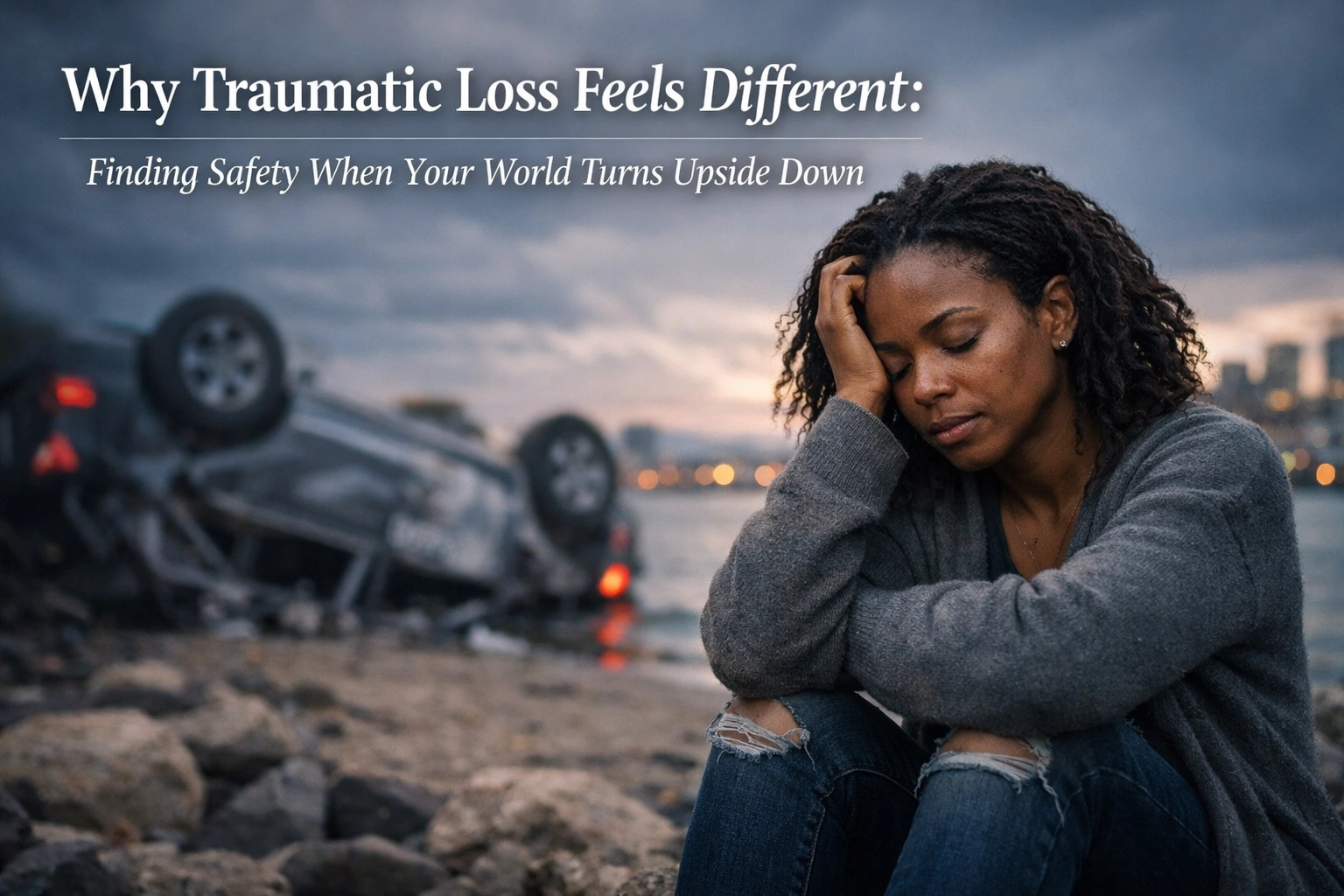
Traumatic loss doesn't just break your heart: it disrupts your nervous system, replays in your mind like a film you can't turn off, and leaves you feeling stuck in shock even months or years after the world shifted beneath your feet.
If you've experienced loss that came suddenly, violently, or in circumstances that felt life-threatening, you already know: this grief feels different. It doesn't follow the "stages." It doesn't respond to well-meaning advice to "give it time." And you're not imagining it: the science confirms what your body has been trying to tell you all along.
When Loss Becomes Trauma
Here's what most people don't understand about traumatic grief: your brain isn't just processing the absence of someone you love: it's responding to a perceived threat to your own survival.
When death happens in traumatic circumstances, your nervous system goes into high alert. It activates the same protective defense mechanisms designed to keep you alive during danger. But here's the challenge: those mechanisms don't automatically turn off once the immediate threat has passed. Your body stays braced for impact long after the storm has moved through.
This is why traumatic loss leads to more than grief alone. Research shows it frequently triggers a trio of challenges occurring simultaneously: prolonged grief disorder, PTSD, and depression. You're not "doing grief wrong": you're experiencing a more severe grief response because the circumstances disrupted your fundamental sense of safety.

The Three Layers of Traumatic Grief
We've come to understand traumatic grief as operating on three interconnected layers, each one affecting how you see yourself, others, and the future:
Layer One: Your View of Yourself
Traumatic loss often brings a storm of self-blame, guilt, and shame. You replay the moments leading up to the loss. You search for what you could have done differently. You carry questions that have no answers and responsibilities that were never yours to bear. This isn't weakness: it's your mind trying desperately to make sense of something that defies sense.
Layer Two: Your Perception of the World
After traumatic loss, the world becomes a different place. You develop what researchers call "heightened vigilance": a constant state of alert, scanning for danger, seeing potential threats everywhere. Trust becomes fragile. Safety feels like a luxury you can no longer afford. You may find yourself isolated, even when surrounded by people who care, because the world no longer feels like the safe place it once was.
Layer Three: Your Sense of the Future
Perhaps the most painful layer is what trauma researchers call a "foreshortened future": the belief that life will never feel normal again, that hope itself has been lost along with the person you loved. The future that once stretched before you now feels impossibly distant or entirely absent.
Did You Know?
Studies show that traumatic loss is associated with significantly more severe grief responses and enduring depression compared to other types of loss. This isn't because you're not resilient enough: it's because the circumstances of the loss have fundamentally changed how your nervous system processes safety, connection, and time itself.
What Happens in Your Body and Mind
When traumatic loss disrupts your sense of safety, your thoughts start to spiral. Intrusive memories replay without your permission. Your emotions swing from numbness to overwhelming intensity. You may experience anger that feels uncontrollable, anxiety that won't quiet, and sadness that crashes over you in waves.
This is your nervous system doing exactly what it was designed to do: protect you. The problem is that these protective responses, while helpful in the moment of crisis, can leave you stuck in a perpetual state of alarm long after you need them.
Your reactions make complete sense. They're not signs that you're broken: they're evidence that your system is working overtime to keep you safe in a world that suddenly feels dangerous.

Finding Safety When the Ground Feels Unsteady
Here's the truth we've learned through working with countless women navigating traumatic loss: recovery isn't about "getting over it" or returning to who you were before. It's about finding ways to steady your thoughts when they start to spiral, to calm your nervous system when it becomes activated, and to rebuild a sense of safety one small step at a time.
Healing from traumatic loss requires addressing both the grief and the trauma. This means:
Learning to recognize when your nervous system is activated and having practical tools to bring yourself back to the present moment. Mindfulness-based practices and self-compassion aren't just wellness buzzwords: research shows they directly reduce the rumination and repetitive distressing thoughts that intensify emotional distress.
Making meaning from the loss without minimizing the pain. Studies indicate that finding ways to maintain connection with your loved one: establishing what researchers call "continuing bonds": reduces symptoms of prolonged grief disorder. You don't have to let go to move forward.
Reframing how you see yourself. While it may feel counterintuitive, research found that maintaining a moderately positive sense of self, rather than engaging in harsh self-criticism, provides a significant coping advantage during recovery from traumatic loss. Your survival matters. Your healing matters. You matter.
You Don't Have to Navigate This Alone
We know that the effects of trauma can follow you throughout your life without proper support. We also know that specialized, trauma-informed care makes a profound difference. Approaches like Cognitive Behavioral Therapy (CBT) and Eye Movement Desensitization and Reprocessing (EMDR) have shown significant effectiveness for grief-related trauma.
But even before formal therapy, there are ways to begin steadying yourself: strategies to calm your nervous system, interrupt the spiral of intrusive thoughts, and find moments of peace even in the midst of profound pain.

Join Us for a Free Live Event
That's why we're hosting a free, live online event specifically focused on traumatic grief: why it feels so different, and what helps when life has been turned upside down.
During this call, we'll explore:
- What makes grief and loss "traumatic" and why your experience is valid
- Why traumatic loss can feel so different from other losses you may have experienced
- The three layers of traumatic grief and how they interact
- Practical ways to steady your thoughts when they start to spiral
- Calming strategies for when you're feeling activated or overwhelmed
- Why your reactions make complete sense and what you can do to calm them
- How to find a peaceful path forward, even when the future feels uncertain
This free, live event takes place on Tuesday, March 3rd at 4 pm ET.
We hope you can join us live, where there will be space for questions and real-time connection. But we understand that timing doesn't always work for everyone: a replay will be provided to all who register, so you can access the content whenever you're ready.
This event is for you if:
- You've experienced a sudden, unexpected, or violent loss
- Your grief feels "stuck" or different from what you expected
- You're struggling with intrusive thoughts or memories
- You feel like your sense of safety has been shattered
- You want practical tools, not just theories, for managing overwhelming emotions
- You're ready to understand what's happening in your body and mind
Finding Your Way Back to Life
Traumatic loss changes you. There's no going back to "before." But there is a path forward: one that honors both the magnitude of what you've experienced and the strength that lives within you still.
You deserve support that understands the complexity of what you're carrying. You deserve tools that actually work. You deserve to know that your reactions aren't signs of failure: they're your system's best attempt to protect you in impossible circumstances.
Register for the event and take the first step toward understanding why traumatic loss feels the way it does: and what you can do to find safety again.
We'll be there on March 3rd. We hope you'll join us.
About the author
Ayana Thomas, Grief Practitioner AKA The Grief Coach, brings over 20 years of experience at the intersection of human services, grief support, and justice-impacted systems. As the founder of Grieving Back to Life, Ayana’s work centers grief beyond death, addressing loss tied to trauma, incarceration, identity, and life disruption through trauma-informed, dignity-centered care.
Her approach combines lived experience and professional practice, creating spaces where grief is witnessed, not fixed, and healing unfolds at a human pace.
Gentle next step
If you’re considering reaching out, you’re welcome to contact us when you’re ready.